


Application Process
Applications will be evaluated until all available slots are filled. Graduate RecordExam (GRE) scores, current transcripts, and three letters of recommendation, and apersonal statement of your goals as a student in experimental psychology are requiredin order to be considered for admission.
- Deadline for Fall admission: March 1
- Deadline for Spring admission: Oct. 1
Admission to the College of Graduate Studies is a dual process: The applicant first has to be accepted by the College of Graduate Studies, and then has to be accepted by the graduate degree program of their choice. The first step in applying to graduate school at MTSU is to apply online. If you have problems, contact the graduate coordinator in the College of Graduate Studies who oversees the discipline in which you are interested.
For further information about the experimental program, contact Dr. Cyrille Magne.
Information for Current Students
Research Lab Directory
| Lab | Research Overview | Area of Specialization |
|---|---|---|
| Brain and Language Lab (BLL)
Director: Dr. Cyrille Magne |
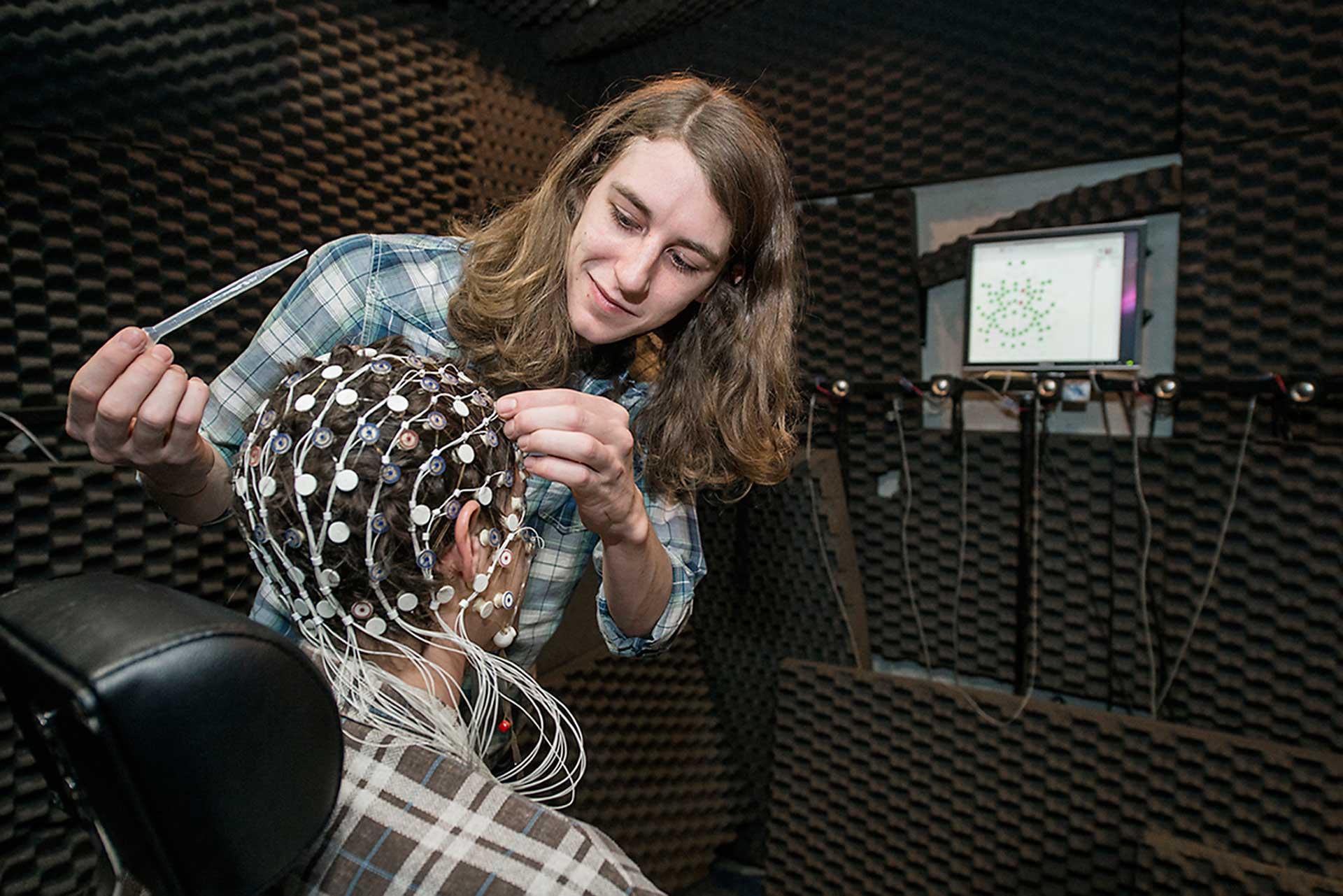
Our research program lies at the interface of Psychology, Neuroscience and Education. The BLL provides a collaborative environment in which undergraduate and graduate students work together to address basic questions regarding the relationship between prosody sensitivity (speech rhythm and intonation), musical aptitude and language skills, using behavioral, eye-tracking and neuroimaging methodologies. |
Neuroscience |
| Identity, Belief, Experience, and Personality (IBEP) Lab
Director: Dr. William Langston |
We are interested in the development and maintenance of belief. The basic model is that beliefs form in one stage and that updating and maintenance of beliefs is a separate stage. Everyday interactions and feedback can lead to perfectly reasonable (albeit anomalous and contrary to reality) beliefs. If the sensory system delivers an experience, and some form of paranormal belief provides a reasonable explanation for that otherwise inexplicable experience, then belief is a perfectly reasonable response. What factors (environmental or endogenous) affect the formation of beliefs? What variables influence the updating of beliefs when new information is provided? Recent projects have been exploring the belief change stage, and my lab is working to evaluate people who have left a belief system to see how experience may play a role in that decision. |
Cognition |
| Lethal Use of Force Lab
Director: Dr. John Pennington |
Promoting the well-being of citizens and police officers through practical, data-inspired interventions designed to reduce the use of lethal force in cases involving unarmed citizens. Each year our lab has approximately 3-4 undergraduate researchers, each exploring a different facet of lethal force. Much of this research is archival in nature — we rely on internet accessible information provided by news media, law enforcement officials, and private citizens (e.g., cell phone videos). To date, these efforts have resulted in student URECA awards, conference presentations, and a recent publication. |
Social Psychology |
| MTSU Cognitive Aging Lab
Director: Dr. James Houston |
In our lab, we explore the way that we process information during the normal aging process. We have many avenues of research in our laboratory, with research projects commonly conducted in the areas of attention, perception, visual word recognition, and working memory. As an experimental psychology laboratory, the majority of our work comprises the assessment of performance in manual and computerized tasks. Along with behavioral measures of performance, we also commonly incorporate measures of neurophysiological activity through our electroencephalogram (EEG) suite. EEG allows for precise measures of underlying functional activity of the brain during engagement in cognitive tasks. |
Neuroscience |
| Olfaction and Taste (OAT) Lab
Director: Dr. Jessica Gaby |
The OAT Lab focuses mainly on how olfactory information (smell) influences our daily lives. We are located in ACB 317. Our current projects include: the impact of olfactory information and body odor in the workplace; the impact of diet on human body odor; olfactory perception of household and social communication odors in cis and trans individuals; the impact of COVID and COVID safety protocols on our relationship to odors in our daily lives. The lab is strongly focused on undergraduate research (though we are always open to taking on grad students!), and Dr. Gaby mentors students in creating and executing their own research projects once they are fully trained. |
Sensation and Perception |
| Social and Affective Neuroscience (SAN) Lab
Director: Dr. Tiffany Rogers |
The SAN lab routinely trains undergraduate students to carry out experiments in mouse models to better understand the neural circuitry underlying social behaviors. We investigate topics such as social motivation and social reward and apply pharmacology and optogenetics to identify neurotransmitter systems involved in typical and aberrant social behavior. |
Neuroscience |
| Translational, Experimental, and Applied Behavior Analysis (TEABA) Lab
Co-Directors: Ann Galizio & Jay Hinnenkamp |
The TEABA lab adopts a three-pronged approach to studying behavior. First, we utilize highly controlled research with humans and rats to study and understand basic learning processes. Second, we also study these same learning processes in more naturalistic and clinical environments to extend our understanding of these concepts and their applicability to everyday behavior. Finally, we use the learning concepts and principles identified in basic and translational settings to address socially significant problems, such as the behavioral deficits associated with autism spectrum disorder. Our current research interests include social behavior, creativity, conditioned reinforcement, and choice. |
Behavior Analysis |
link