


e-Portfolio
The Cathay General Hospital e-portfolio system was established in 2019, tested in 2020, and officially launched online in 2021. It was designed to enhance training and evaluation for NPGY trainees through a secure, scalable, and user-centered digital platform. Developed using JAVA and JSP Servlet, it operates on a DB2 database within a high-security AIX environment, managed via a WebSphere web server on a Windows server. Unlike traditional e-portfolio systems, which primarily function as document repositories and basic assessment tools, this platform integrates automated task management, interactive feedback, and multimedia capabilities, making it a comprehensive, real-time learning support tool. The system comprises three core components: 1. Announcements and reminders – delivers real-time notifications regarding learning activities, deadlines, and important updates to ensure trainees remain engaged and informed. 2. Electronic assessments – supports a comprehensive suite of evaluation tools, including direct observation of procedural Skills (DOPS), entrustable professional activities (EPAs), clinical practice assessments, counseling records, inter-professional patient-centered care discussions, and examination records. This integrated assessment framework enables both formative and summative evaluations, allowing trainers to provide timely feedback while enabling trainees to monitor their progress effectively. 3. Learning progress outcomes – provides a structured evaluation framework that facilitates progress tracking, automated reminders for pending tasks, and data-driven insights into trainees’ learning trajectories. The system also supports bi-directional feedback, fostering continuous engagement between trainees and educators to refine the learning experience.
Study design
This study employed a cross-sectional questionnaire survey to evaluate the impact of the e-portfolio system on learning effectiveness, self-efficacy, and job satisfaction among NPGY trainees. The study was conducted at Cathay General Hospital over a two-year period, from January 1, 2022, to December 31, 2023. The detailed research framework, outlining the participant selection process and assessment components, is presented in Fig. 2.

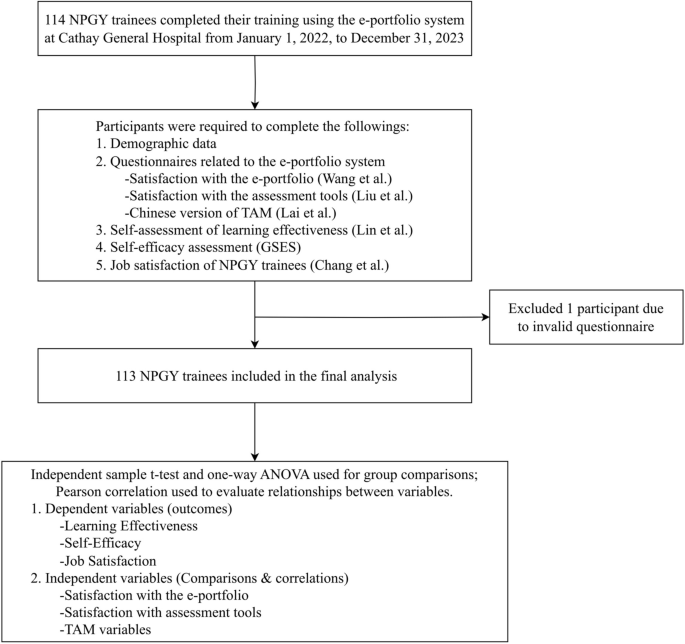
Flowchart of this study. This flowchart presents the study design, participant selection, data collection, and statistical analysis process. A total of 114 nursing postgraduate year (NPGY) trainees at Cathay General Hospital completed their training using the e-portfolio system between January 1, 2022, and December 31, 2023, with 113 included in the final analysis after excluding one invalid questionnaire. Participants completed demographic data collection and questionnaires assessing satisfaction with the e-portfolio system (Wang et al.), satisfaction with assessment tools (Liu et al.), and technology acceptance model (TAM) variables (Lai et al.), as well as self-assessments of learning effectiveness (Lin et al.), self-efficacy (GSES), and job satisfaction (Chang et al.). Data analysis involved independent sample t-tests and one-way ANOVA for group comparisons, while Pearson correlation analysis examined relationships between satisfaction with the e-portfolio, assessment tools, TAM variables, and the dependent variables of learning effectiveness, self-efficacy, and job satisfaction
Participants
Eligible NPGY trainees who completed their training using the e-portfolio system at Cathay General Hospital within the specified study period. Participant data were obtained from the hospital’s education department and submitted to the clinical medical personnel training program under the teaching hospital teaching expenses subsidy management system of the Ministry of Health and Welfare. Specific exclusion criteria were applied to ensure data integrity and relevance. Subsequently, eligible trainees were invited to participate in the study by members of the research team, independent of their direct supervisors, in order to minimize potential biases. The inclusion and exclusion criteria were as the followings:
-
(1)
Inclusion criteria:
-
1.
Nursing staff who meet the subsidy standards of the Ministry of Health and Welfare (i.e., receiving teaching subsidies within 2 years and obtaining a nursing license within 4 years).
-
2.
Individual aged 20 years or older.
-
3.
Individual who is able to communicate in Mandarin, comprehend Chinese, and complete the questionnaire.
-
1.
-
(2)
Exclusion criteria:
-
1.
Less than one month of employment.
-
2.
Resignation.
-
1.
To determine the required sample size, a power analysis was conducted using G*Power 3.1 based on Pearson correlation analysis, as used in this study. A bivariate normal model was selected, with the significance level (α) set at 0.05 and power (1—β) at 0.8. According to Cohen’s criteria, a medium effect size (r = 0.3) was assumed (medium effect size was chosen because previous studies in nursing education and competency-based training have commonly reported effect sizes in this range [24, 25]), requiring a minimum of 84 participants for adequate statistical power. To account for potential data loss and invalid responses, an additional 5% attrition rate was applied, leading to a final target sample size of 114 participants. This sample size ensures sufficient power to detect statistically significant relationships among the study variables.
Ethical considerations
This study was approved by the institutional review board of the Cathay General Hospital (CGH-P112071). All methods were performed in accordance with the Declaration of Helsinki. Written informed consent was obtained prior to the survey, and participants were ensured that the information they provided would be kept anonymous.
Measurement
This study employed a questionnaire-based measurement approach, which was structured into five sections to assess key study variables. The first section collected demographic data, including participants’age, gender, educational background, and years of nursing experience.
The second section focused on the e-portfolio system, comprising three distinct groups of items. The first group measured satisfaction with the e-portfolio, adopting items from the satisfaction questionnaire developed by Wang et al. [11] This scale utilized a 5-point Likert scale, ranging from 1 (strongly disagree) to 5 (strongly agree), with higher scores indicating greater satisfaction. The second group assessed satisfaction with the assessment tools, using eight items adapted from the questionnaire on teachers’ and trainees’ satisfaction with assessment tools developed by Liu et al. [26] These items were also rated on a 5-point Likert scale, where higher scores reflected a higher level of agreement. The third group measured variables from the TAM, specifically perceived usefulness, perceived ease of use, and behavioral intention to use. This section adopted the Chinese version of the TAM scale developed by Lai et al. [27] and was scored on a 7-point Likert scale from 1 (strongly disagree) to 7 (strongly agree), with higher scores denoting stronger agreement.
The third section focused on self-assessment of learning effectiveness, utilizing a questionnaire developed by Lin et al. [28] This scale consisted of three items, rated on a 5-point Likert scale from 1 (strongly disagree) to 5 (strongly agree), with higher scores indicating greater perceived learning effectiveness.
The fourth section measured self-efficacy, using the Chinese version of the General Self-Efficacy Scale (GSES) developed by Zhang and Schwarzer [29]. This scale comprised 10 items, each rated on a 4-point Likert scale, with response options ranging from 1 (not at all true), 2 (hardly true), 3 (moderately true), to 4 (exactly true), where higher scores reflected higher levels of self-efficacy.
The final section assessed job satisfaction, using nine items from the job satisfaction of NPGY trainees questionnaire developed by Chang et al. [30] Participants rated each item on a 5-point Likert scale, ranging from 1 (very dissatisfied) to 5 (very satisfied), with higher scores representing greater job satisfaction.
Internal consistency reliability
The internal consistency reliability of each scale was assessed using Cronbach’s alpha coefficients based on responses from the study sample. The Cronbach’s alpha values were as follows: satisfaction with the e-portfolio (α = 0.927), satisfaction with assessment tools (α = 0.955), TAM scale (α = 0.984), job satisfaction scale (α = 0.940), general self-efficacy scale (α = 0.960), and learning effectiveness self-assessment (α = 0.955). The overall internal consistency across all items was α = 0.980. These results indicate good to excellent internal reliability for all scales used in this study.
Data analysis
Following the completion and return of the questionnaires, all responses were coded and systematically entered into an excel file for data management. All questionnaires were fully completed, and no missing data were identified; therefore, no imputation or additional handling procedures were necessary. Statistical analyses were conducted using SPSS version 25.0. A normality test was first performed to assess the distribution of the data, after which parametric statistical methods were applied for inferential analysis. Since the study variables were based on the summation of multiple Likert-type items into total scores, these scores were treated as approximately continuous variables, allowing the application of parametric statistical analyses such as independent sample t-tests, one-way ANOVA, and Pearson correlation. The significance level (α) for all statistical tests was set at 0.05.
Descriptive statistics were employed to summarize the demographic characteristics of the participants and to present the distribution of scores for each scale related to the e-portfolio assessment. The data were reported in terms of frequency, percentage, mean, and standard deviation (SD). To examine differences in learning effectiveness, self-efficacy, and job satisfaction across different participant groups, independent sample t-tests and one-way analysis of variance (ANOVA) were conducted. Additionally, Pearson correlation analysis was performed to evaluate the relationships between participants’ satisfaction with the e-portfolio, satisfaction with the assessment tools, and the variables of the TAM in relation to their learning effectiveness, self-efficacy, and job satisfaction.
link