


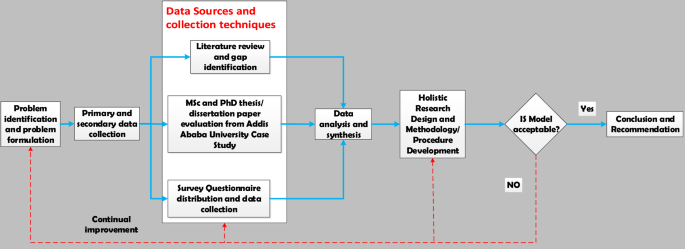
Several studies have informed the development of this holistic research methodology process model. Ganesha et al., 2022 focused on the development of research questions by PhD scholars but did not provide a comprehensive overview of the entire methodology process. Additionally, literature indicates that 36–51% of PhD attrition can be attributed to challenges in the research dissertation process and factors contributing to success (Sonia et al., 2019).
Previous models have notable limitations. Wenjing et al. (2017) and Ranjit Kumar (2015) relied on commonly understood method definitions without detailing each step. Most models exhibited a linear or “open-loop” framework that failed to account for potential challenges that may arise. Furthermore, models presented in the SISP book (2023) concentrated on planning, data collection, analysis, and interpretation, neglecting the crucial stage of model development. Many frameworks merely outlined basic research methods without addressing the subsequent steps after analyzing results.
These gaps highlight the need for a holistic overview of the complete research process, one that accounts for potential difficulties and thoroughly explains each component, including model building. Findings from the literature review, case study, and survey underscore the necessity for a comprehensive process model to guide PhD students through each sequential and iterative part of developing their research methodology and dissertation.
This section aims to develop a holistic research methodology procedure that researchers across disciplines can easily understand and apply. Many studies indicate that postgraduate and early-career researchers often struggle to conduct their research effectively and complete it within specified timelines. Another significant finding is the inconsistency in research methodology deployment within the same university, as observed across different colleges (as noted in Table 2). The results of the questionnaire survey also suggest that many postgraduate students lack a comprehensive research methodology to guide their work. To address the needs identified in the survey responses, the resulting framework was designed around established methodological approaches while considering practical challenges.
The new model aims to provide a more holistic, flexible, and transferable research methodology applicable across various disciplines. It incorporates elements from existing process models but restructures them into a comprehensive, step-by-step workflow. Existing research indicates that current research methodology models often lack comprehensiveness and standardization across disciplines (see Table 1). As evidenced by the earlier summarized literature review, case studies, and survey findings, previous frameworks exhibit certain drawbacks.
For instance, they do not fully depict the sequential nature of the entire research process, overlook potential difficulties, and fail to provide universal guidance applicable to all fields of study. This study clearly outlines the need for a standardized, holistic methodology supported by empirical research on existing challenges and unmet needs of researchers.
Given these findings, the next critical step is to develop a research methodology process model that addresses the identified gaps. By integrating best practices from the literature with real-world insights, the proposed framework aims to offer a standardized, step-by-step workflow to guide researchers throughout their projects, regardless of specialization. This approach has the potential to enhance research quality while also supporting novice scholars in navigating the methodology component, ultimately advancing postgraduate education.
The following section will outline the methodology developed based on the evidence presented thus far. To reduce variability and confusion among researchers and to address barriers to understanding, this section aims to develop a holistic research methodology deployment procedure and model. As shown in Fig. 8 and explained in detail here, the holistic research methodology procedure and framework are developed.

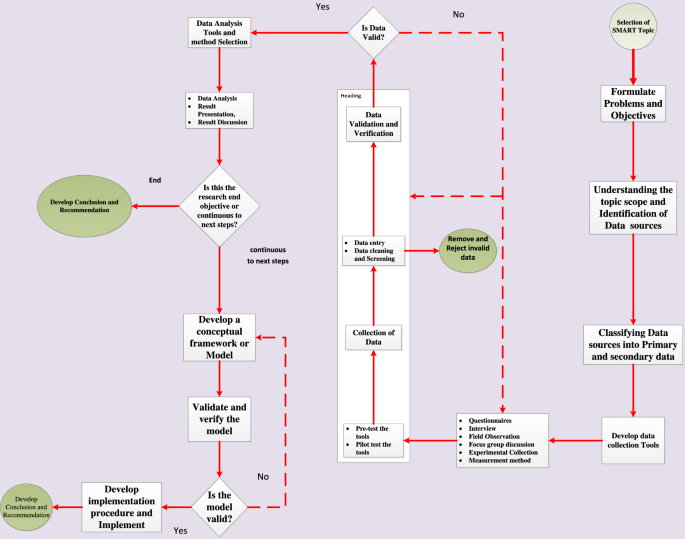
Holistic Research Methodology Flow Diagram (Author).
Selection of SMART Research Topic
In this step, researchers must select a timely or thematic research area based on their interests. Choosing a SMART (Specific, Measurable, Achievable, Relevant, and Time-bound) research topic is crucial for conducting a focused and successful study. Postgraduate students, whether pursuing a PhD or MSc, should concentrate on research that can be completed within a specified timeframe. Once researchers identify the thematic research agenda within their field, they can develop a justification and objectives for their study.
Problem Formulation and Objective Development
This second step involves identifying problems, assessing the background, and developing research questions based on issues identified in the preliminary literature survey and personal experiences (Ganesha et al., 2022). Researchers formulate core and specific objectives based on the justification of the identified problems. After defining the objectives, they establish the scope and significance of the study and set delimitations to define the research boundaries.
Understanding Topic Scope and Identification of Data Sources
Once the research objectives are developed, researchers proceed to establish the significance of the study and define its scope. The scope is crucial as it sets boundaries for the research area, particularly concerning time constraints (Murad et al., 2020). This clarity allows researchers to determine potential data sources and focus their efforts accordingly.
Classifying Data Sources into Primary and Secondary Data
Classifying data sources into primary and secondary categories is essential in research methodology. Primary data sources involve collecting information directly from original or firsthand sources. Common methods for gathering primary data include surveys, experiments, observations, and focus group discussions. Secondary data, on the other hand, refers to information previously collected by others for different purposes but that can be utilized for current research. Examples of secondary data sources include published literature, government reports, organizational reports, databases, and online data sources.
Developing Data Collection Tools
After identifying data sources, the next step is to develop data collection tools. These tools are essential for gathering the necessary data to address the research questions and objectives.
Testing Tools
Testing the clarity and validity of data collection tools is crucial before distribution. Researchers typically employ pre-testing and pilot testing to ensure the effectiveness of their tools. Pre-testing involves assessing the clarity, comprehension, and usability of the tools with a small sample of selected individuals. This preliminary testing helps identify potential issues, such as confusing questions or unclear instructions. Feedback from pretest participants can guide revisions and improvements to the tools. After making necessary adjustments, researchers conduct a pilot test, deploying the refined tools in a real-world context with a small-scale sample representing the intended participants. However, this approach has not been consistently followed across related research, as noted by previous studies highlighting methodological irregularities (Wenjing et al. (2017); Ranjit Kumar, 2015). The pilot test aims to evaluate the tools’ performance in a realistic environment.
Collection of Data and Screening
Once the data collection tools are tested and deemed reliable, researchers collect data and enter responses into the tools used for analysis. The collected data undergoes screening and cleaning, which helps researchers discuss results accurately and provide precise data analysis.
Data Validation and Verification
The screened data must be validated and verified based on the collected information. Any unnecessary data can be adjusted during this process to ensure the correctness of the research findings.
Data Analysis Tools and Method Selection
Researchers must select appropriate methods for analyzing the collected and screened data. This step is vital for discussing and presenting findings using the identified data analysis tools and methods.
Data Analysis and Result Discussion
This section focuses on analyzing and presenting the data. Data analysis dissects the collected information from various sources. Once the data is analyzed, it can be discussed by comparing findings with existing related literature. If the objective of the research is to present findings and offer conclusions and recommendations, the study concludes here. However, if the study aims to develop a model or framework based on the findings, the next steps continue (as indicated in Fig. 8).
Developing a Conceptual Framework or Model
After presenting and discussing the results, researchers need to develop a model that addresses the research gap and provides solutions. This model is based on the research theme area and is subjected to validation. Many traditional frameworks fail to outline clear next steps for operationalizing insights into applicable or theoretical frameworks, leaving researchers uncertain about how to translate their results into implementable contributions. Specifically, Wenjing et al. (2017) noted that methodologies often lack direction for researchers aiming to develop their findings into concrete models.
Developing Procedures for Implementation and Implementation
Once the model is validated for operability, the next step is to develop procedures for implementing it. This implementation requires thorough follow-up and collaboration with relevant industries.
Conclusion and Recommendation Development
The final phase involves writing conclusions based on the findings and making recommendations to stakeholders. This stage also outlines research directions for future work.
The newly developed holistic research process methodology model underwent pilot testing with a group of Master’s and PhD students related to the case study area. During the presentation and review of the framework, students provided feedback, finding it useful and applicable to their research endeavors.
Following this positive evaluation, the aim of the resulting holistic research methodology model is to provide researchers at all levels with a comprehensive, interdisciplinary, and user-friendly guide for designing rigorous, relevant, and impactful studies. By integrating insights from literature and real-world case analyses, the model addresses key limitations and unmet needs in current research methodology approaches.
The model’s flexible modular structure allows for adaptation across various research contexts, while the incorporation of innovative methods accommodates real-world complexities. A suite of practical decision-making tools and resources supports researchers, especially novices, throughout the design process.
Overall, this holistic research methodology model represents significant progress toward enhancing consistency, coherence, and rigor across academic disciplines. By bridging theory and practice, the goal is to empower researchers at all career stages to conduct high-quality, impactful studies through a standardized methodology, thereby expediting the research process.
link