
Augmented Reality Surgical Simulation Market: Bridging the Gap
Augmented Reality Surgical Simulation Market
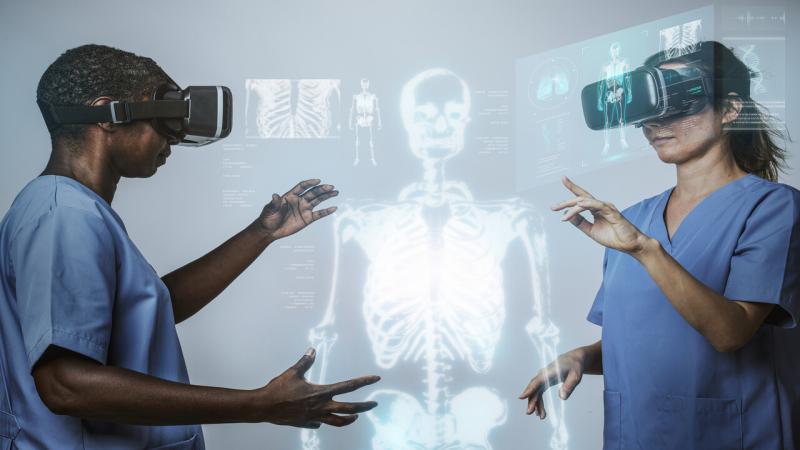
The Augmented Reality (AR) Surgical Simulation Market is revolutionizing medical education and preoperative planning by overlaying digital anatomy onto the physical world. Unlike Virtual Reality (VR), which creates a completely immersive synthetic environment, AR allows surgeons to interact with realistic 3D holograms while maintaining awareness of their physical surroundings and instruments. This market is driving a fundamental shift from the traditional “see one, do one, teach one” apprenticeship model to a “competency-based” training approach. By enabling residents to practice complex procedures on “Digital Twins” of patients-complete with anatomical variations and pathologies-AR simulation is significantly reducing medical errors, shortening the learning curve, and eliminating the ethical and logistical constraints of cadaver-based training.
Market Dynamics & Future:
Innovation: Growth is fueled by the integration of Haptic Feedback technology, which allows trainees not just to “see” the hologram but to “feel” tissue resistance and bone density, adding a critical tactile dimension to the simulation.
Operational Shift: There is a decisive move toward Patient-Specific Rehearsal, where surgeons upload a patient’s actual CT/MRI scans into the AR system to practice that specific, unique surgery hours before entering the operating room.
Distribution: Partnerships between medical device manufacturers (who need to train doctors on new tools) and AR software developers are becoming the primary channel for adoption.
Future Outlook: The market will be defined by Remote Telementoring, where expert surgeons use AR to “project” their hands and instructions into the field of view of a trainee operating in a different country, democratizing access to surgical expertise.
Click Here, Download a Free Sample Copy of this Market: https://marketresearchcorridor.com/request-sample/15786/
Drivers, Restraints, Challenges, and Opportunities Analysis:
Market Drivers:
Patient Safety Focus: The zero-tolerance policy for preventable medical errors is driving hospitals to mandate simulation training for credentialing, ensuring surgeons are proficient before touching a patient.
Shortage of Cadavers: The rising cost, ethical concerns, and scarcity of human cadavers for training are forcing medical schools to adopt high-fidelity digital alternatives.
Complexity of Minimally Invasive Surgery: As procedures become less invasive (keyhole surgery), the need for advanced hand-eye coordination training provided by AR increases.
Market Restraints:
Hardware Costs: High-end AR headsets (like HoloLens or Magic Leap) and accompanying haptic sensors remain expensive, limiting widespread adoption in smaller clinics and developing nations.
Latency & Registration: Any lag between the user’s movement and the hologram’s response can cause motion sickness or negative training transfer, where the surgeon learns “bad habits” due to tech glitches.
Key Challenges:
Verisimilitude (Realism): Creating software that accurately mimics the unpredictable behavior of soft tissue (bleeding, deformation) in real-time remains a massive computational challenge.
Standardization: There is currently a lack of standardized scoring metrics for AR simulation, making it difficult to compare proficiency levels across different institutions.
Future Opportunities:
5G Integration: The rollout of 5G will eliminate latency issues, enabling cloud-rendered, photorealistic simulations on lightweight glasses.
Robotic Surgery Training: integrating AR simulation directly into robotic consoles (like da Vinci) to train surgeons on robotic controls without using the actual expensive robot.
Get to know more about this Report: https://marketresearchcorridor.com/schedule-the-call/
Market Segmentation:
By Component:
Hardware (AR Headsets, Haptic Sensors, Display Monitors)
Software (Anatomical Modeling, Training Modules)
Services (Maintenance, Custom Development)
By Application:
Orthopedic Surgery (Spine, Joint Replacement)
Cardiovascular Surgery
Neurosurgery
General Surgery (Laparoscopy)
ENT & Cranio-Maxillofacial
By End User:
Academic & Medical Institutes (Medical Schools)
Hospitals & Surgical Centers
Medical Device Manufacturers (For Product Training)
Region:
North America
U.S.
Canada
Mexico
Europe
U.K.
Germany
France
Italy
Spain
Rest of Europe
Asia Pacific
China
India
Japan
South Korea
Australia
Rest of Asia Pacific
South America
Brazil
Argentina
Rest of South America
Middle East and Africa
Saudi Arabia
UAE
Egypt
South Africa
Rest of Middle East and Africa
Competitive Landscape:
Top Simulation & Software Specialists:
CAE Healthcare
3D Systems (Simbionix)
Mentice
VirtaMed
FundamentalVR
Touch of Life Technologies (ToLTech)
Osso VR
ImmersiveTouch
Hardware & Tech Enablers:
Microsoft Corporation (HoloLens)
Magic Leap
Google LLC
Ultraleap (Haptics/Hand Tracking)
Regional Trends:
The global market is segmented into North America, Europe, Asia-Pacific, Latin America, and the Middle East & Africa.
North America (Market Leader): Dominates the global landscape, driven by the presence of major medical simulation centers and strict accreditation requirements for residency programs. The U.S. is the innovation hub for integrating AI assessment tools into AR training.
Europe (Standardization Hub): Growth is shaped by cross-border collaboration between universities and hospitals. European regulators are increasingly viewing simulation-based training as a requirement for certifying new surgical techniques.
Asia-Pacific (Fastest Growth): Expanding rapidly due to the proliferation of new medical schools in China and India. Governments are investing in digital simulation labs to train a massive workforce of new surgeons efficiently to meet the needs of large populations.
Market Dynamics and Strategic Insights
The “Flight Simulator” Model: The market is driving healthcare toward the aviation model, where pilots (surgeons) must log hours in a simulator before flying a plane (operating on a patient). This cultural shift is the biggest long-term growth driver.
Objective Assessment: Unlike human mentors who may be subjective, AR simulators provide objective data-tracking hand tremors, path efficiency, and time taken-giving residents unbiased feedback on their skills.
Pre-Operative Planning: The line between “Training” and “Practice” is blurring. Surgeons are using AR not just to learn general skills, but to plan complex tumor removals by visualizing the patient’s anatomy in 3D before making the first incision.
Device Marketing: Medical device companies are the “hidden” whales of this market. They are buying custom AR simulations to demonstrate their new implants or tools to surgeons, replacing expensive travel and wet labs with portable virtual demos.
Get A Report Copy of this Market: https://marketresearchcorridor.com/request-sample/15786/
Contact Us:
Avinash Jain
Market Research Corridor
Phone : +1 518 250 6491
Email: [email protected]
Address: Market Research Corridor, B 502, Nisarg Pooja, Wakad, Pune, 411057, India
About Us:
Market Research Corridor is a global market research and management consulting firm serving businesses, non-profits, universities and government agencies. Our goal is to work with organizations to achieve continuous strategic improvement and achieve growth goals. Our industry research reports are designed to provide quantifiable information combined with key industry insights. We aim to provide our clients with the data they need to ensure sustainable organizational development.
This release was published on openPR.
link




![Locum tenens offers physicians a path to freedom [PODCAST]](https://kevinmd.com/wp-content/uploads/Design-4-scaled.jpg "Locum tenens offers physicians a path to freedom [PODCAST]")
