Medical interns and senior medical students’ perceptions toward clinical teaching | BMC Medical Education

A total of 229 responses were initially collected from senior medical students and medical interns. After excluding responses from universities outside Saudi Arabia, the final sample included 227 respondents from Saudi universities. Based on an estimated total of 1,400 students reached, the approximate response rate was 16.2%. Participant characteristics are presented in Table 1. About half of the respondents were females (n = 120, 52.9%) and the majority were 6th year senior medical students (n = 144, 63.4%).
As indicated in Tables 1, 146 (64.3%) of respondents did not have any previous teaching experience. On the other hand, the students who experienced teaching before were peer tutors (n = 51, 22.4%), lecturers (n = 43, 18.9%), or assistant teachers (n = 13, 5.8%). Additionally, more than half of the students (n = 133, 58.6%) did not participate in medical education research. Most of the surveyed individuals (n = 173, 76.2%) plan to work in an academic hospital. There were three preferred future residency specialties received the highest selection by the students, which included internal medicine (n = 41, 18.1%), pediatric (n = 26, 11.5%), and surgery or one of its branches (n = 23, 10.1%). Most respondents (n = 159, 70.0%) had an elective period in their final year of medical school, while the remaining 30% (n = 68) did not.
Furthermore, most participants (n = 172, 75.8%) expressed an interest in pursuing clinical teaching upon completion of residency, choosing the desire to ‘give back’ as a major motivational factor (Fig. 1). When asked about interest in participating in a medical education elective, less than half (39.2%) indicated interest (Fig. 1).
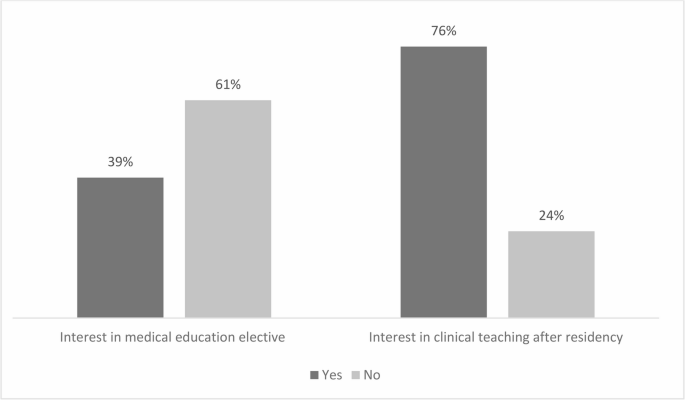
Responses of 227 medical students about their interest in participating in medical education elective during the last year of medical school vs. pursuing clinical teaching after residency
Regarding the preferred duration of such an elective, the most frequently selected option was one month (n = 80), followed closely by two weeks (n = 76). A statistically significant association was observed between interest in the medical education elective and interest in clinical teaching after residency (p < 0.001), suggesting that those interested in the elective were more likely to pursue clinical teaching after residency.
Chi-square tests were conducted to examine the association between gender and academic level with interest in the medical education elective and plans to pursue clinical teaching after residency. None of the associations were statistically significant (all p-values > 0.05) (Table 2).
Many respondents felt confident in presenting to others (n = 141, 62.1%) (agreeing and strongly agreeing on the Likert scale), facilitating small group sessions (n = 166, 73.1%), giving verbal feedback (n = 147, 64.8%), and writing feedback (n = 141, 62.1%). Approximately half of the respondents felt confident performing bedside teaching (n = 116, 51.1%) and teaching about sensitive issues, communications, and ethics (n = 110, 48.5%). However, less than half felt confident regarding presenting at a journal club (n = 91, 40.1%) (Table 3).
Figures 2 and 3 illustrate the mean confidence scores across various teaching-related skills, comparing students based on their interest in medical education electives and clinical teaching. In Fig. 2, students interested in the medical education elective consistently reported higher confidence across all competencies compared to those not interested. Both groups reported the highest confidence in facilitating small group sessions, but the largest differences were observed in bedside teaching (mean 3.75 vs. 3.28) and presenting at a journal club (3.48 vs. 3.01). Similarly, Fig. 3 shows that students who expressed interest in pursuing clinical teaching after residency reported higher confidence in all assessed skills. The most notable differences were seen in confidence presenting at a journal club (3.37 vs. 2.65) and teaching sensitive topics such as communication and ethics (3.48 vs. 2.96).
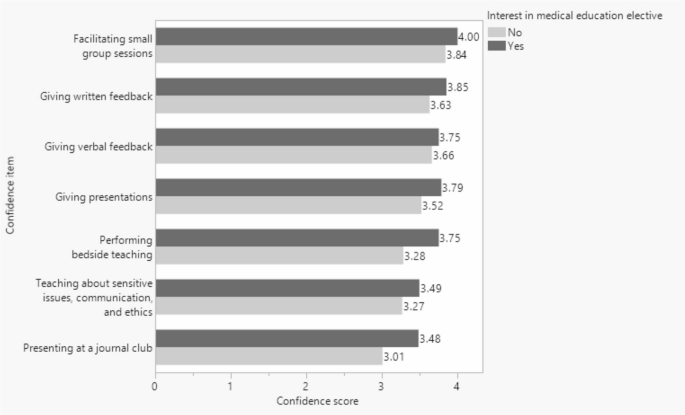
Mean confidence scores across teaching-related skills, comparing students interested and not interested in the medical education elective. Items are ranked by mean score in the interested group
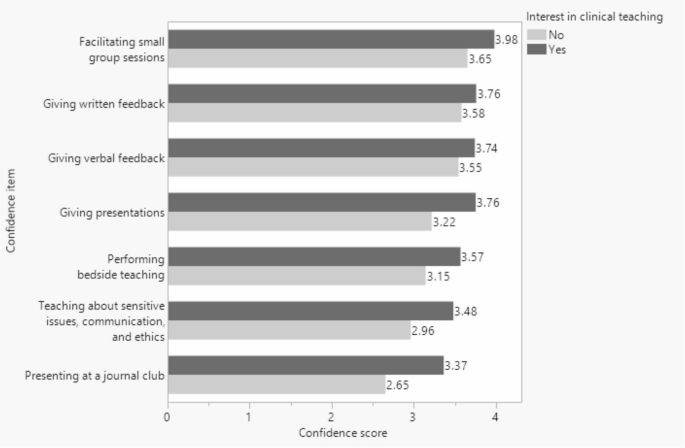
Mean confidence scores across teaching-related skills, comparing students who are interested and not interested in pursuing clinical teaching. Items are ranked by mean score in the interested group
Chi-square analyses were conducted to examine associations between interest in medical education elective and clinical teaching after residency and confidence levels across the seven teaching-related items. Regarding interest in the medical education elective (Table 4), significant associations were found for performing bedside teaching (p = 0.012) and presenting at a journal club (p = 0.019), with interested students more likely to report high confidence in these areas. In comparison, interest in clinical teaching (Table 5) was significantly associated with four items: giving presentations (p = 0.002), performing bedside teaching (p = 0.034), teaching about sensitive issues (p = 0.011), and presenting at a journal club (p < 0.001). Across both domains, those expressing interest were consistently more confident in core teaching tasks, particularly bedside teaching and journal club presentations.
Supplementary Table 1 presents the association between gender and academic level with self-reported confidence across various teaching-related competencies. No statistically significant differences were found between males and females or between interns and sixth-year students in any of the confidence domains.
Most of the survey respondents stated that bedside teaching (n = 137, 60.4%), teaching physical exam skills (n = 106, 46.7%), effective moderation of small group learning (n = 97, 42.7%), and effective presentation skills (n = 89, 39.2%) are important topics that should be discussed in a medical education elective as shown in Table 6.
link


![Locum tenens offers physicians a path to freedom [PODCAST]](https://kevinmd.com/wp-content/uploads/Design-4-scaled.jpg "Locum tenens offers physicians a path to freedom [PODCAST]")