
The effectiveness of VR-based human anatomy simulation training for undergraduate medical students | BMC Medical Education

This study aimed to evaluate the effectiveness of a VR-based human anatomy simulation training program for undergraduate medical students in Tunisia. The primary objective was to assess the impact of VR-based learning on students’ understanding of anatomical structures and to explore how it compares to traditional learning methods.
Study design and sample selection
To determine the appropriate sample size (S), Cochran’s equation was applied, ensuring statistical validity with a 95% confidence level and an expected proportion (P) of 0.5. This calculation was chosen because the total number of students in the target population was known, relatively small, and limited, making it a suitable method for accurately estimating the required sample size while maintaining representativeness. The calculation was based on recent statistics from the Ministry of Higher Education, which detail the number of undergraduate students over the past two years. By using this approach, we ensured that the selected sample accurately reflected the broader student population, allowing for reliable conclusions about the effectiveness of VR-based anatomy training.
$$S=\frac{{{X^2}.N.P.\left({1 – P} \right)}}{{{d^2}.\left({N – 1} \right)+{X^2}.P.\left({1 – P} \right)}}$$
X = 1,96 (1% error, 95% standard confidence).
P: Population portion (30-50%).
P = 50%.
d = 0.05 (standard degree of accuracy).
N = Number of estimated populations.
To ensure a fair and unbiased selection process, a simple random sampling (SRS) method was used to select 179 students from Ibn Al-Jazzar Faculty of medicine, Sousse. This approach provided each student with an equal chance of selection, minimizing bias and ensuring a representative sample. Students were then randomly assigned to either the experimental group (VR-based training) or the control group (traditional learning methods) using a computer-generated randomization list. This process ensured an even distribution of participants across both groups, reducing selection bias and allowing for a balanced comparison of outcomes.
We used the following python code to create the two groups. The script will ensure an even distribution and output the assignments in a structured format (Fig. 1).
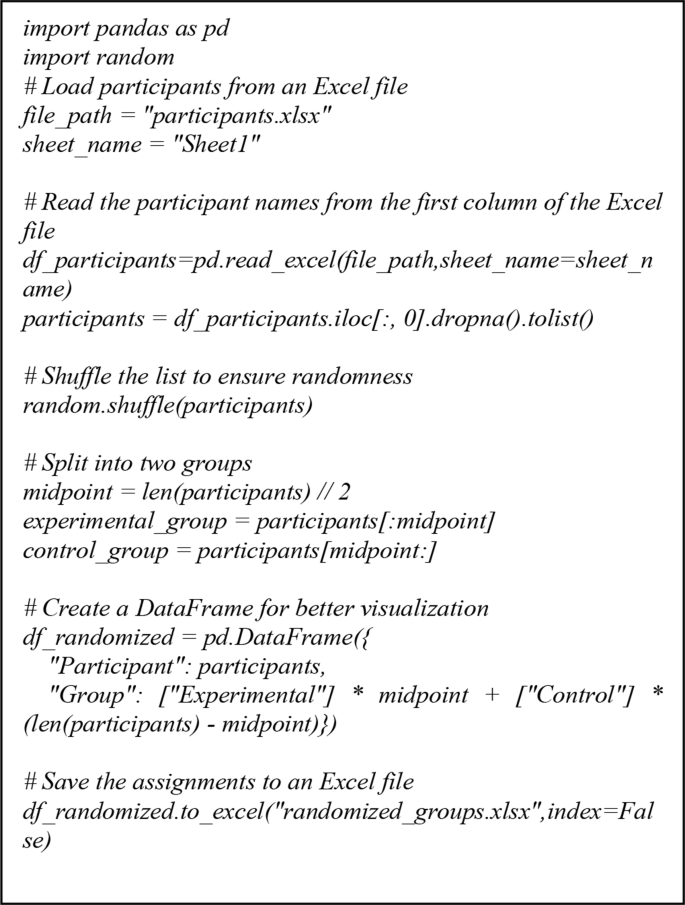
The script to randomly generate experimental and control groups
Eligibility criteria
The study focused on first- and second-year medical students, as the VR scenarios were specifically designed to align with their theoretical knowledge and curriculum. This selection ensured that the anatomical content was relevant and appropriate for their level of study. Eligible participants met the following inclusion criteria:
-
Enrollment in the first or second year of medical school to ensure alignment with the anatomy curriculum.
-
No prior experience with VR-based anatomy training to avoid bias in learning outcomes.
-
No medical conditions that could interfere with VR use, such as severe motion sickness, epilepsy, or visual impairments that could compromise the immersive experience.
-
Willingness to participate and provide informed consent, ensuring ethical compliance.
Setting and recruitment
The study was conducted within the medical school’s anatomy department, where students regularly engage in both theoretical and practical anatomy courses. Recruitment was carried out through student emails and in-class announcements. Interested students were invited to an informational session where they were briefed on the study’s purpose, procedures, potential benefits, and risks.
Those who met the eligibility criteria and agreed to participate provided written informed consent.
Demographics and gender distribution
Participants’ ages ranged from 18 to 23 years, with a mean age of 20.3 years and a standard deviation of 1.4 years. To ensure gender representation, the closest possible numbers of male and female students were selected, resulting in a final sample of 98 females and 81 males, closely reflecting the university’s enrollment distribution. This balance helped ensure that findings were generalizable across both genders.
Normality testing & effect size reporting
In our study, we conducted normality testing to assess the distribution of the data before performing statistical analyses. The Shapiro-Wilk test was used to determine whether the data followed a normal distribution. This test was applied to key variables such as training session attendance and time spent in the VR environment, ensuring that the data met the assumptions for parametric tests and validating the strength of our results.
To quantify the magnitude of differences between VR-based training and traditional learning methods, we reported effect sizes. For comparisons using t-tests, we applied Cohen’s d, which provides a standardized measure of the difference between the two groups. By incorporating both normality testing and effect size reporting, we ensure a more comprehensive and transparent interpretation of the data, allowing for a clearer understanding of the effectiveness of VR-based training compared to traditional methods.
Handling of missing data
In cases where data were missing, we applied listwise deletion, ensuring that only complete datasets were analyzed. This approach helps maintain the integrity and validity of the results while minimizing potential biases that could arise from incomplete data.
Confidence intervals and p-values
We have ensured that confidence intervals (95% CI) and p-values are consistently reported throughout the results section. This provides a clearer interpretation of statistical significance and the precision of our estimates, particularly when comparing the outcomes of VR-based training and traditional learning methods. By consistently including these values, we aim to enhance transparency and facilitate a more comprehensive understanding of the effectiveness of the interventions.
Confounding variables
To control confounding variables (e.g., prior human anatomy knowledge, gender distribution…), we conducted multivariate regression. This analysis ensured the observed effects were attributed specifically to the VR intervention rather than external influences.
Questionnaire development and validation
The questionnaire used in this study was designed to assess students’ perceptions of the VR simulation and compare it to traditional learning methods. The eight questions focused on key aspects such as engagement, memorization, and anxiety reduction.
To ensure validity and reliability, a professional team of teachers and faculty members with expertise in medical education and human anatomy reviewed and validated the questionnaire. Their feedback was incorporated to refine the questions, ensuring they accurately captured students’ experiences with the VR simulation and its potential advantages over traditional methods.
The questionnaire was divided into two sections.
The first section comprised Likert scale questions (from 1 to 5) to quantitatively assess the effectiveness of the VR training. Each question targeted specific factors, including:
Engagement: How engaging did you find VR training?
(1 = Not engaging, 5 = Highly engaging)
Effectiveness: How effective was VR training in helping you learn anatomy?
(1 = Not effective, 5 = Extremely effective)
Anxiety Reduction & Memorization: Do you think virtual training could alleviate your apprehension and improve memorization of human anatomy?
(1 = Not helpful, 5 = Very helpful)
The second section consisted of open-ended questions, allowing students to share their perspectives, highlight strengths, and provide constructive feedback on improving the VR platform.
Pre- and post-simulation responses were analyzed to identify shifts in perception and assess the impact of VR training on students’ learning experiences.
Study procedure
Pre-Simulation phase
Students attended a 15-minute lecture on using the VR application to familiarize themselves with the immersive experience. Afterward, they completed a pre-simulation survey to assess their initial perceptions of VR-based learning, including memorization, pre-exam anxiety.
VR simulation and assessment
Before the study, a preliminary test was conducted to determine the optimal duration for each session, ensuring that students had sufficient time to engage in the virtual environment without experiencing cognitive overload or fatigue. Based on the results, it was decided that each student would have 45 min to explore, learn, and complete the quiz. This timeframe allowed for meaningful interaction with the VR platform while maintaining focus and engagement.
The selected students explored the virtual human anatomy lab, with a primary focus on the skeletal and muscular systems. Inside the VR environment, they had access to highly detailed 3D anatomical models, which they could interact with using various tools.
Students were able to rotate, zoom in, and manipulate structures to examine internal relationships from multiple perspectives, simulating a real dissection experience. This hands-on approach provided an immersive learning experience, reinforcing theoretical knowledge through active exploration and visualization.
Following their interaction with the anatomical models, students were required to complete a six-question quiz integrated into the VR platform. Each question was designed to assess their comprehension of key anatomical structures and concepts. To maintain the integrity of the assessment, each question could only be answered once, encouraging students to apply critical thinking and recall their observations accurately. These quizzes served as realistic simulations of formal assessments, helping students familiarize themselves with exam-style questioning in an interactive setting.
Upon completing the quiz, students received immediate feedback on their performance. This feedback highlighted correct and incorrect responses, allowing students to review their mistakes, reinforce learning, and address any gaps in their understanding. Such an approach not only enhanced knowledge retention but also provided a self-paced learning experience that encouraged continuous improvement.
At the end of the simulation, students exited the virtual lab by selecting the “Go Home” button, which redirected them to the main menu, officially concluding their session (Fig. 2).
This structured workflow ensured that students followed a guided yet flexible learning path, maximizing their engagement with the VR platform while facilitating a seamless transition between exploration, assessment, and review (Fig. 2).

Overall process of the study
Instructors may play a crucial role in the learning process, adapting their teaching styles to integrate VR into anatomy education. The VR session was displayed on a smart TV or other screens, allowing instructors to monitor students’ progress, identify learning gaps, and provide real-time assistance.
This setup enabled a more interactive teaching experience, where instructors could guide students, clarify misunderstandings, and reinforce complex anatomical concepts. Additionally, the multiplayer option introduced a new dimension to teaching by allowing instructors to join the virtual environment as avatars. In this setting, they could directly interact with students, provide instant feedback, and lead discussions in a dynamic and engaging virtual classroom. This feature transformed traditional teaching into an interactive and collaborative learning experience, enhancing student engagement and comprehension through a more immersive and personalized approach.
Post-simulation phase
Students completed a post-simulation survey, which included the same eight questions as the pre-survey, assessing various aspects of the VR training, such as accuracy, realism, ease of navigation, engagement, impact on memorization, and reduction of exam-related anxiety. An open-ended section allowed students to share feedback on the VR platform and its influence on their anatomy learning experience, helping guide future improvements. Most students remained motivated to continue using the platform throughout the academic year. To further strengthen our study, we maintained contact with all participants for follow-up at six months and one year. This follow-up also allowed us to evaluate long-term knowledge retention, providing valuable insights into the lasting impact of VR-based learning on students’ understanding of human anatomy.
Data analysis
Survey responses were collected electronically over the course of one academic year and analyzed using Microsoft Excel. The data was analyzed through frequencies and percentages to evaluate the impact of the VR simulation and its perceived benefits on students’ learning experiences.
A comparative analysis was conducted between the pre- and post-survey results to assess changes in student perceptions, particularly regarding the effectiveness of VR in comparison to traditional learning methods.
Our statistical models and findings were validated by an independent biostatistics expert, ensuring robustness and accuracy of the analytical framework.
Before participating in the study, all students signed a written informed consent form after being provided with a detailed explanation of the study’s objectives, procedures, potential benefits, and any associated risks. An informational session was conducted to ensure that participants fully understood the research process, their voluntary participation, and their right to withdraw at any time without consequences.
The study strictly adhered to ethical guidelines, including the Declaration of Helsinki and institutional research ethics standards. Ethical approval was obtained from the university’s ethics committee (DECISION N°256 [Ref: CEFMS 256/2024]), ensuring compliance with all relevant regulations. Confidentiality and anonymity of participant data were maintained throughout the study, with all collected information securely stored and used solely for research purposes.
By implementing these measures, we ensured that participants’ rights, safety, and privacy were fully protected throughout the research process.
link




![Locum tenens offers physicians a path to freedom [PODCAST]](https://kevinmd.com/wp-content/uploads/Design-4-scaled.jpg "Locum tenens offers physicians a path to freedom [PODCAST]")
